
Get the latest museum news sent to your inbox!
Get the latest museum news sent to your inbox!
More Events Coming Soon!
Sat.
Nov 14th
2 PM
Bottled Promises - The Story Behind Dr. Solomon's Indian Wine Bitters
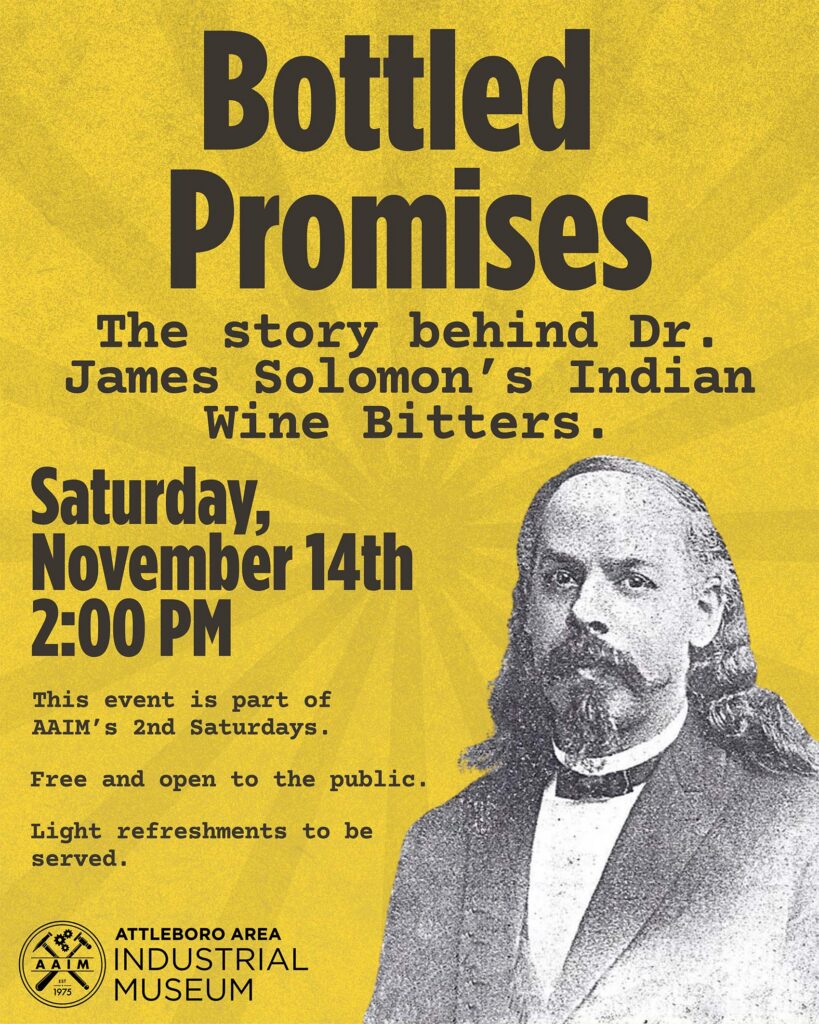
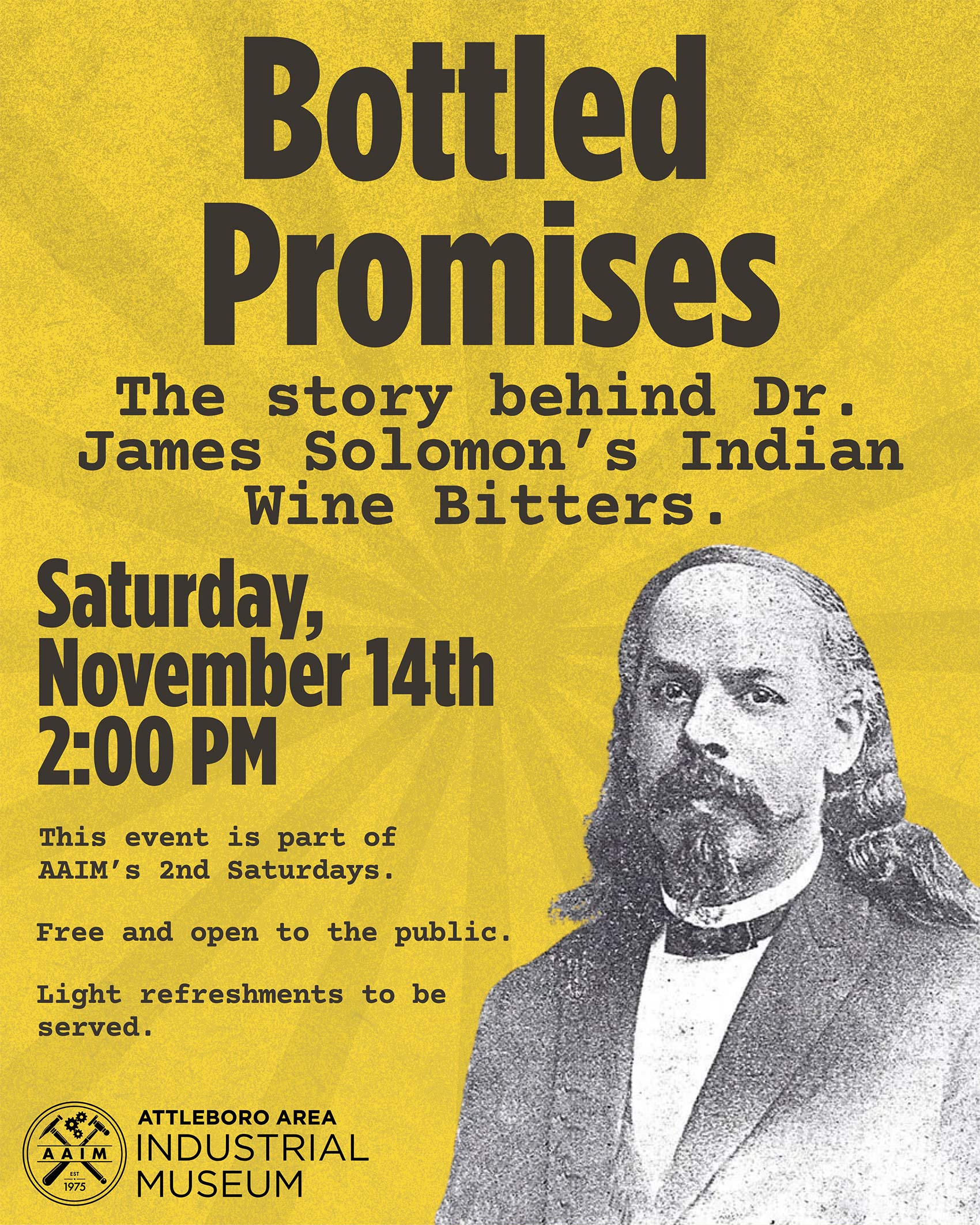
In the 1800s, Americans turned to “patent medicines,” secret-formula tonics backed by big promises and no science. One line of patent medicines got its start right here in Attleboro.
Made by “Dr.” James M. Solomon Sr., it was sold at the Ashley Drug Company, formerly on Park Street. The most popular products were “Old Dr. James Solomon’s Indian Wine Bitters” and “Old Dr. Solomon’s Great Indian Bitters,” supposedly based on Solomon’s own formulas. In fact, he was neither Indigenous nor a doctor.
Yet he found immense success advertising his product to people looking for the perfect cure-all, who hoped his bottle of herbal remedies could solve all their problems, from tuberculosis to cancer to stubborn acne.
Join the Attleboro Area Industrial Museum on Saturday, November 14, at 2:00 p.m. to learn more about this local snake-oil salesman. This event is free and open to the public. Light refreshments will be served.
This program is presented as part of Second Saturdays at the Attleboro Area Industrial Museum. Each month brings a different topic and a new way to engage with the stories of Attleboro and the region.
Questions? Email director@industrialmuseum.com or call (508) 222-3918.
Sat.
Aug 8th
2PM - 4PM
Second Saturdays: Please Return This Bottle

Please Return This Bottle features a collection of vintage bottles largely dating to the first half of the 20th century, offering visitors a window into not only what people were buying, but how those products were marketed and sold.
Many of the bottles on display bear embossed or raised lettering identifying the bottling company, its location, the product’s intended use, and its date of manufacture — details that made the bottle and its contents inseparable in the eyes of consumers.
These artifacts also hold significance beyond marketing history. Archaeologists frequently use bottles to help date historical sites, since manufacturers regularly changed bottle shapes and hallmarks throughout the 19th and 20th centuries. Medicine bottles in particular can offer clues about the illnesses people treated, their spending habits, and whether they shopped locally or ordered goods from afar.
Please Return This Bottle is presented as part of AAIM’s Second Saturdays series, held from 2:00PM to 4:00PM on the second Saturday of each month.
This event is free and open to the public.
We hope to see you there!

Thurs.
Feb. 26th
5:00 - 7:30PM
Planting Attleboro’s Pocket Forest - Presentation

Attleboro is taking steps to reduce flood and stormwater damage and increase drought resilience by creating a “Pocket Forest” with a great diversity of tree species that will collaborate to deepen soils that absorb and hold water, many times that of a stand of a single tree species.
Volunteers are being scheduled for April 2026 to plant 500 native trees and shrubs of over forty different species in a circular plot near Capron Park Zoo and Attleboro High School.
During a reception, 5:15 to 6:00 pm, Attleboro High School students will present posters and projects that demonstrate the benefits of planting a pocket forest.
Presentations begin at 6:00pm.
Deanna Wells-Scott, AHS Marine Science Teacher, and Chris Hitchener, lead education coordinator for Mass Audubon’s Oak Knoll Wildlife Sanctuary, will discuss Attleboro’s connections to the sea and the work of AHS Marine Science students.
Kirby Ruggieri, an AHS Environmental Science teacher, will discuss life in soils and how a diverse range of forty native woody plants, trees, and shrubs can be a much better carbon sponge, holding water, than a stand of just a few tree species.
John Rogan, PhD, Geography Professor, Human-Environment Regional Observatory, Clark University, will present the work of Clark Students monitoring and measuring the climate resilience of two Miyawaki pocket forests in Worcester, Massachusetts.
Rob Moir, PhD, Executive Director of the Ocean River Institute, will discuss how plant diversity, when applied using methods developed by botanist Akira Miyawaki, improves stormwater management, reduces flooding, and increases drought resilience.
The Industrial Revolution began in Attleboro in 1780 with the opening of a brass button factory. The Earth Rehydration Revolution, a grassroots environmental movement, focuses on restoring the “small water cycle” by keeping rainwater in the soil instead of letting it runoff into the ocean, which helps reduce the heat-trapping effects of water vapor in the atmosphere and cools the local climate.
It starts here in Attleboro. Come learn about the plans for a Pocket Forest in our backyard, and discover how you can make a lasting difference with a spade and a sapling.
Kelly Bergeron and AHS’s media team, “Blue Reporters,” will film the event.
Questions? Email director@industrialmuseum.com or call us at (508) 222-3918.


